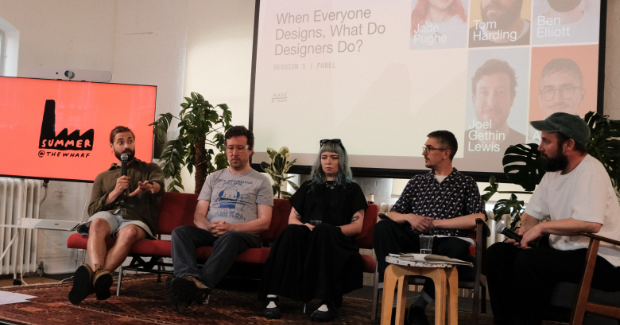
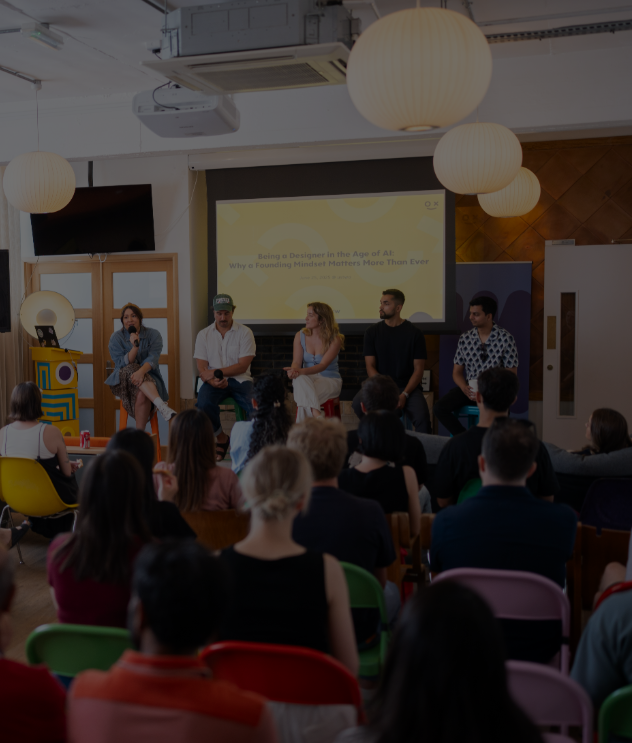
In June, Made by Many opened Diespeker Wharf in Angel, London, for its Summer Festival: two days of talks on AI, design, digital identity and internet culture. Jokingly referred to as an SXSW fringe event, it was grassroots, driven by curiosity and full of real people (no bots).
Our founder Ben Elliott joined a panel on the role of designers in the era of AI, alongside Adam Morris, VP of Product Design at The Economist, Tom Harding, Managing Director of Made by Many, Jade Pughe, Creative Technologist at Mother London, and Joel Lewis, Course Convener at the Creative Computing Institute, University of the Arts London.
It's a topic that comes up on our calls every week. Product Managers prototype in Claude Code, engineers generate interfaces in Cursor, and founders mockup screens before they've hired a designer.
So, when everyone can ‘design’, what do designers actually bring to the table? Here's what we're seeing.

1. Stop judging designers by how fast they produce screens
A decent-looking interface is now a prompt away, so a portfolio of polished screens tells you very little. What's harder to fake is the thinking behind them: the problem they chose to solve and the options they ruled out.
In interviews, ask designers to walk you through a real trade-off they made. You'll learn more from that than from a page of mockups.

2. Hire for judgement, not just execution
When anyone can generate ten versions of a feature in a minute, the scarce skill is knowing which one is right: what to leave out, when it's good enough to ship, when a flow will confuse people. AI can produce options. It can't yet tell you which one your users will trust.
For designers, this is the work to put front and center. Hiring managers tell us craft and product-thinking are what separates a strong designer from someone who's simply quick with the tools.

3. Bring design in before the solution is decided
If a Product Manager can prototype an idea in an afternoon, the first version can become the plan before anyone asks whether it solves the right problem.
The best teams we work with involve design while the problem is still being framed, not just when it's time to make it look good. If your designers only see the work once the direction is set, you're paying for their least valuable skill.

4. Be clear about whether you need a designer who builds
We're seeing more demand for Design Engineers and for Product Designers who ship working front-end, not just Figma files. That suits small, talent-dense teams, where each hire must cover more ground.
But it isn't right for every team. Plenty of excellent designers add the most value through research, design systems or interaction craft. Decide which you need before you write the job ad.

5. Keep investing in how designers learn their craft
Much of the work that used to train junior designers (resizing assets, building screens, documenting components) is now quick to automate. That raises a fair question about where the next generation of Lead Designers will learn the basics.
Employers can help by pairing juniors with senior designers, giving them real problems rather than production work, and making time for proper critique. For designers earlier in their career, learn the tools, but don't let them replace the habit of asking why.

So what do designers do now?
The message from the panel was clear: AI might shape the future of design, but it isn't replacing designers any time soon. Designers decide what's worth making, and they make it good. That matters more now, not less.
If you're hiring a designer and want to talk about what the role should look like, we'd love to help.
A little bit about us
Found By Few has helped designers find their next role since 2021, with agencies, tech startups and blue-chip companies across the UK and Europe. Looking for your next design role? Say hello at hello@foundbyfew.com.